
Make Bad Art!
Planting the seeds of our collectively liberated future in the rich compost of what we are currently burning to the ground.


This post was written by NQC facilitator, Sonya Gracey
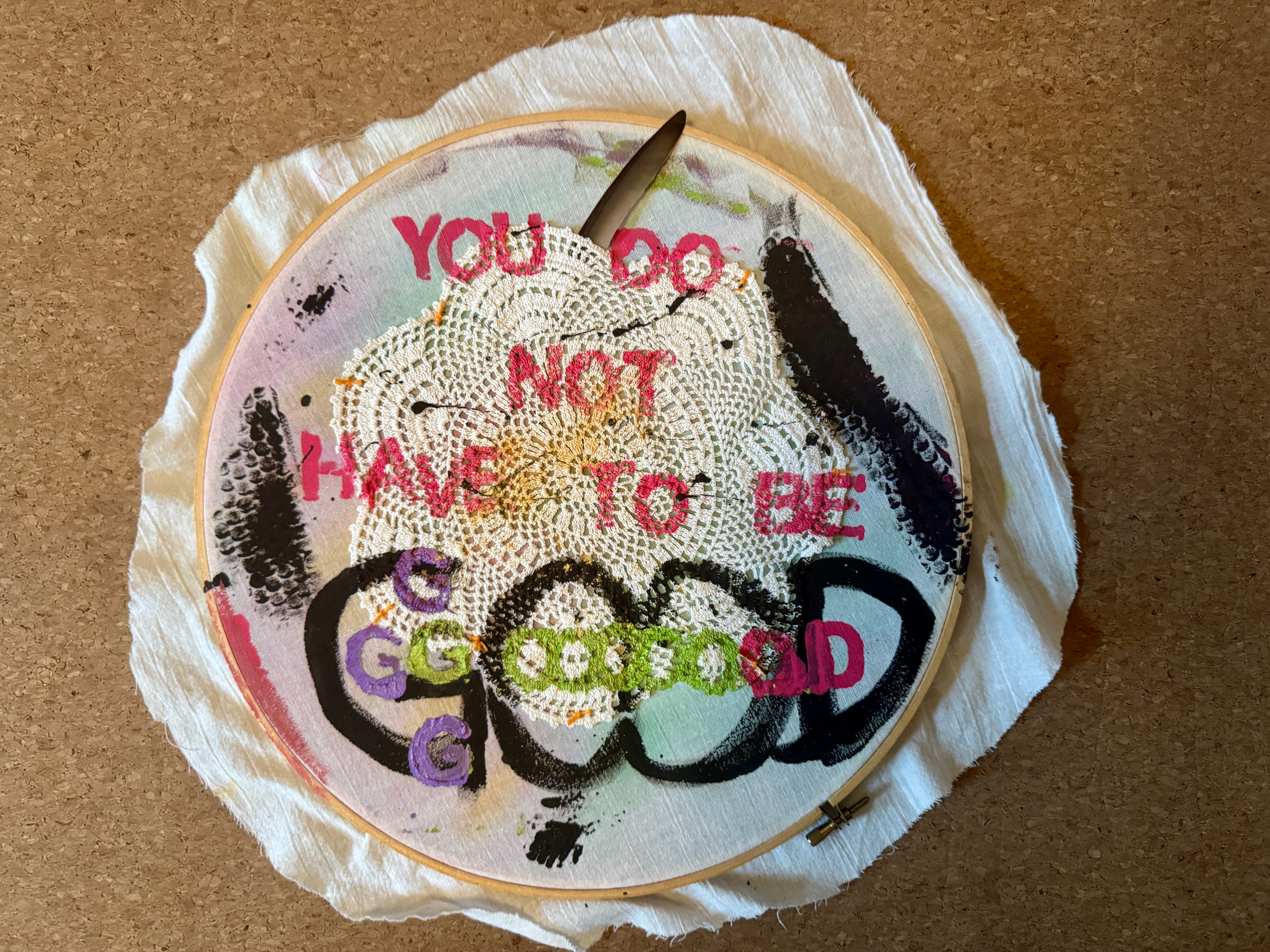
Ok, so…all my art is bad. Like, literally all of it. Most of it I would not care if I ever saw again. I have no idea about colour theory or composition, I do not have a handle on the ‘fundamentals’ of art, or design. I actually hate everything I make when I am making it. It looks amateur, or juvenile, or unpolished or unfinished, or I don’t know. It just always looks ‘not good enough’ when I am making it (although now if I look at it a week later I usually love it!) And for most of my life, that meant I did not make it. I was not an artist, or a creative. I was not allowed in that club because I didn’t have a portfolio, I wasn’t in an upcoming show, I didn’t have price tags on my latest ‘piece’. I had a very limited understanding of who an artist was. I mostly thought they were snobs or disasters. They were all out there, gorgeous and stylish, at high end gallery shows small talking about shit that sounds more important than it is, over expensive wine and pop culture gossip, OR they were living alone in a shitty ashtray filled apartment above a nearly empty convenience store, spending days and nights creating heaps of brilliant art that no one would see until they died and were deemed a master. Either way, I did not identify with or aspire to this. So I excluded myself.
Until my people started to die and I was given the critical and creative inspiration of grief.
Over the last decade I have lost both my parents, the father to my kids, and several dear friends. Pair that with divorce, covid, perimenopause, financial insecurity, single parenting in the hell-fire of global collapse and what resulted was twofold. I developed a strong critical analysis, and a survival relationship with creativity and art. Grief gave me the capacity to see the power, and power hoarding, whiteness and colonialism, patriarchy and misogyny, lineages of lies and obstruction and violence that I benefited from for 40+ years of life. I needed a way to metabolize the truth of it all. There were so many rocks and so many hard spots that I couldn’t control or think my way out of. I started HAVING to make art (to scribble, and rip, and glue and stack, and…) just to release some of the building tension, the accumulated feelings in my body, in my heart. It was from here that I saw that art is not actually about product. Art is the ritual process and fingerprint of our humanity; our living. Our art is necessary; our creative life force is necessary. Growing and tending our creative capacities is direct resistance to the fascist regime of conformity. Making Bad Art is world-making; it is planting the seeds of our collectively liberated future in the rich compost of what we are currently burning to the ground.
Art does not have to be good, because good is irrelevant in this revolution! Our intention in Bad Art club is to fuel our collective commitments to the risk taking of inquiry and emergence in our daily living, to depathologize our creative existence and validate our own ways of being/knowing/feeling. This longing for us to know ourselves and each other outside of what is definable; to be un-understandable and beyond words and worthy of love is true and possible in creative practice. I’ve tasted it. And let me tell you: it is fucking magical!
Bad Art club is an invitation to spend an hour or so being reminded that you already, inherently belong and that you are needed! Come find out what happens when we stop performing our creativity towards good art, and start letting ourselves unfurl through small successions of creative choices.
Bad Art Club is an invitation into a mutual practice of letting go. Letting go of perfectionism, of expectation, of productivity, of control, of performance…. It’s like a creative exhale. When you come hang with us you will soon see the benefits of releasing attachment to art as a product and stepping into art as a process. A process of getting to know yourself in a community, exploring perspectives and ideas that often live only in your beautiful creative brains.
When you come to Bad Art Club you will be invited to release ideas about art as a commodity or art as beauty, and find your way to seeing the art you make as a representation of your essence, of your being! There is nothing more radical, more liberating than being YOU in ways that challenge the rigid confines of social norms. Many of us neuroqueers have spent much of our lives trying to fit in, trying to belong and stay safe performing inside of socially constructed norms - and it hurts us, and all those living across intersections of silenced and excluded experiences. But no more - we are calling the bluff - we have pulled back the curtain. We know its bs and that’s why we are here in Neuroqueer Creative!!
We are done with the performance! We want to know and share ourselves, we want to participate in world making that rejects one-right-way thinking. And that’s what we do in the Bad Art Club - here there are no rules. We actively reject and resist rules like colour in the lines, follow the directions, copy this exactly, make this look pretty …and instead we trust ourselves, we follow curiosity and emergence. We scribble, and make marks, and play with texture and shapes, repetition and patterns. We center inquiry and connection and meaning making. We witness and celebrate each other wholeheartedly as we uncover and explore all that comes when we are open to creative possibility.
And if that is not enough here are some more ways that Bad Art Club can support you in your day to day life:
Lowers Stress Hormones: Engaging in creative activities has been shown to significantly reduce cortisol levels (the body’s primary stress hormone) regardless of artistic skill or experience.
Encourages Emotional Expression: Art provides a non-verbal language for expressing difficult or complex feelings that may be hard to put into words. This externalization of emotions in a safe, non-judgmental space helps in processing them and prevents them from remaining bottled up and causing internal stress.
Interrupts Negative Thought Patterns: The act of making art, especially simple activities like doodling or coloring, requires focus and present-moment awareness, which can interrupt repetitive, looping anxious thoughts (rumination) and provide a break from our own spin.
Interrupts Time: When immersed in the creative process, especially within a ritual container, we let go of linear time and let go into our own senses of time and external demands. This meditative state naturally reduces anxiety and helps the nervous system relax.
Activates the Brain’s Reward System: Creating art activates the brain’s reward centers, releasing feel-good neurotransmitters like dopamine and serotonin. This neurochemical response makes the experience pleasurable!
Builds Flexibility: By providing ourselves space to explore challenges and find creative solutions within the art, we develop better problem-solving abilities and emotional responsiveness strategies
Fosters Self-Awareness and Self-Esteem: The process of creating art and reflecting on it helps you connect with your inner self, discover hidden feelings, and build a sense of accomplishment. This boosts self-esteem and self-awareness
SEE YOU THERE!
Bad Art Club meets via Zoom on the second Sunday of every month from 7-8:30pm UK, starting February 8th 2026 and is co-facilitated by Sonya Gracey & Leif.
Sonya Gracey is a polydisciplinary creator whose practice is rooted in living decolonization, neuroqueer world-making, and justice-oriented mutual care (that sure is a mouthful! they are also at times very playful/goofy, and considered by some to be hilarious)
A white settler of irish, germanic bukovinian ancestry Sonya currently lives on and benefit from the unceded stolen lands of the Xwsepsum and lək̓ʷəŋən peoples colonially known as vancouver island canada. Sonya’s practice is an emerging action of coming into right relationship with land, place and time - and the impact that their ongoing presence on unceded lands has on local peoples.
As a recovering benevolent their work is deeply personal and related to thier own lived experiences of struggle, grief and transformation. They are a neuroqueer solo mom to two autistic teens surviving in capitalism. Having spent 23 years as an RN working in healthcare (street outreach, reproductive justice, harm reduction) she became increasingly aware of the violence of the status quo and the role she played in that. Last year they gave up their registration as a nurse – but kept all the lived experience with people and relationships! Refocusing their practice towards art, and creative practice she works from a decolonial, intersectional framework that centers relationship and access.
Through relational, somatic (body-based) art-making, Sonya’s work fosters emergent growth, embodied political action, and a critical awareness weaving the interconnectivity of the personal, collective, and systemic narratives and movements that shape us and that we shape.
Sonya has a Masters in Public Health, a graduate certificate in systems design, and has completed their Art Therapy post grad at Kutenai Art Therapy Institute. They are currently a member of the Canadian Art Therapy Association, a facilitator with the Erotics of Liberation Practice Field and a care weaver member with The Liberatory Wellness Network (LWN).
Sonya also co-facilitates the Bad Zine Club with Leif, and facilitates Unlearning Whiteness, and our monthly Unlearning event series.
NQC Clubs are ‘practice’ spaces where members of the community meet to engage in particular creative practices, with gentle guidance and invitations from facilitators. These meet monthly throughout the year and can be joined (or left) at any time, via monthly subscription.
Neuroqueer Creative monthly practice clubs include: Queer Book Club, Bad Art Club, Bad Zine Club & Writing Club. Subscribe to one club for £6 a month, two for £11, or all four for £20. Join our Skool Community to access all four clubs at a 10% discount (£18) and receive a 5% discount on all NQC courses.